A new seminar series with sensory expert Dr. Hoby Wedler explores wine through every sense. The 100% Cork campaign has partnered with Dr. Hoby Wedler, a blind...

When you choose a wine or spirit sealed with a natural cork, you are making the responsible choice. You are supporting an endangered forest ecosystem that protects wildlife and biodiversity, sustains rural communities, and combats soil erosion, wildfires and desertification. You are removing vast quantities of CO2 from the atmosphere.
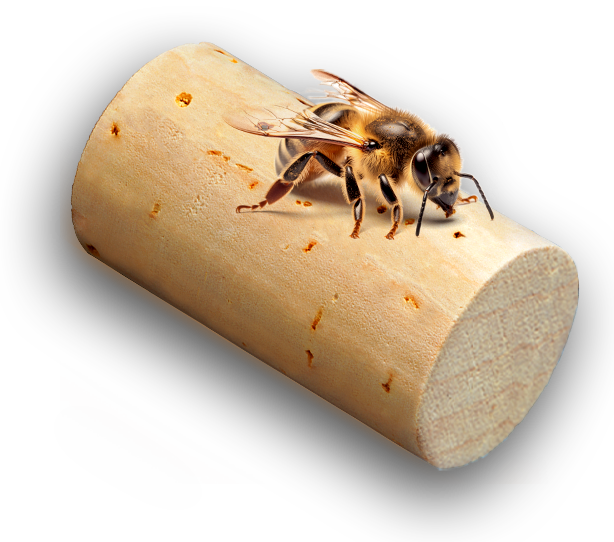
Take mindful consumption beyond moderation. Choose a wine or spirit topped with a 100% recyclable, renewable, and regenerative material that not only signifies quality and makes everyday moments special, but protects the planet. So drink responsibly — for yourself, your community, and the bee.
ABOUT CAMPAIGN
The Drink Responsibly, Choose a Bottle with a Natural Cork campaign from the Portuguese Cork Association (APCOR) and the Natural Cork Council seeks to educate consumers and industry on how cork harvesting supports biodiversity and preserves Portugal’s cork oak forests; and to position natural cork as a premium, sustainable material that makes the highest quality bottle closures.
Cork is the bark of Quercus suber, the cork oak — an evergreen native to the western Mediterranean. Cork oaks are drought and fire resistant, perfectly adapted to their native environment.
The bark is stripped by hand, with an axe, by skilled workers employed in one of the highest-paid agricultural jobs in the world. Families, communities, an entire culture, live from and care for cork forests, known as the Montado. No machinery, no chemicals, no felling. The tree isn’t harmed and in fact is healthier — it simply regrows its bark, on a nine-year cycle, for 200 years or more. Each time the bark regenerates, it pulls CO2 from the atmosphere, making a cork tree one of the world’s best carbon sinks.
The Montado is an iconic Portuguese savannah-like landscape where cork oaks have grown naturally for thousands of years. Like the African savannah, it is a landscape where human culture and nature
have lived for centuries in perfect harmony: the livelihoods of pastoralists, foragers, and farmers were sustained by the land, and in return they protected the ecosystem and allowed it to continuously regenerate, ensuring the health of the community, and a habitat that supported its many unique species. In modern times, the economic value of cork is the lynchpin of this whole ecosystem. That is what makes choosing a bottle with a natural cork the responsible choice.
Cork bark is 89% air, which is why it is so light. Its strength and elasticity come from a honeycomb of tiny cells that never break down under pressure. Press a
These two gifts of nature made from earth, sun, and water, have been intertwined, on and off, since antiquity. Greeks and Romans used cork atop amphorae for the same reason we do: nothing else grips and gives at once. The practice faded during the long centuries of wooden barrels, then came back for good in the 1600s when glassmakers were finally able to produce bottles that were uniform and strong enough to lie on their side. Cork was the only material pliable enough to seal them shut and let them age. Even today, no technology or invention has ever been engineered that can replace the utility and elegance of the iconic combination of cork and glass. Routinely, bottles that are decades or even centuries old have been found intact, protected by cork.
Not a single tree is cut down. The bark is stripped by hand once every nine years, and the same cork oak keeps giving for 200 years.
Learn Why
The World Wildlife Fund calls the harvest “one of the finest examples of traditional, sustainable land use”. The Montado is one of the most biodiverse landscapes in the Mediterranean, home to more than 135 plant species in a single square meter, and to species with nowhere else left to go, from the Iberian lynx to wintering common cranes. The arithmetic of cork is genuinely rare: a natural cork keeps holding the carbon it absorbed while the tree was growing, even after it’s removed from the bark — and once you subtract the small emissions of stripping, transporting and shaping it, a single cork still locks in more CO₂ than its own production released. That’s not low-emission. That’s carbon-negative, one stopper at a time.
One cork oak forest, harvested for 200+ years without ever being felled — supporting roughly 100,000 livelihoods across the Mediterranean along the way.
Much imitated, never equaled, cork is impermeable to liquid and gas yet still allows wine to breathe and develop inside the bottle.
Learn Why
This seeming contradiction is resolved due to cork’s unique cell structure. It is the air trapped inside the cork itself that is released into the bottle in measured, predictable amounts, just enough to allow maturation without oxidation, resulting in balanced yet complex wines. That is why virtually all of the world’s best wines are sealed with cork. But whatever the wine or its price point, a cork atop a bottle signifies the wine was made with care and respect for the person who will enjoy it, because people recognize cork, trust it, and value it. That is why even after centuries cork still closes over 70% of wine bottles worldwide.
91% of Wine Spectator’s Top 100 wines are sealed with natural cork. Not because cork is only for icon wines, but because winemakers at every level reach for the closure that signals care.
Cork is the overwhelming preference of wine lovers everywhere, and not only for what it protects, but for what it represents…
Learn Why
…and how it feels and sounds. Nobody has ever recorded the satisfying sound of a screwcap. The pull and give of a natural cork — soft resistance, then release — is one of the happiest sounds there is — the sound that starts a celebration before a single glass is poured. It says something is about to be shared. Only cork turns opening a bottle into a small announcement — unhurried, a little theatrical, unmistakably elegant and sophisticated in a way nothing synthetic or manufactured can match. And when the bottle is empty, people routinely take the cork home as a memento of the occasion. When was the last time someone took home a screw cap?
But most of all — it’s the happiest closure, and gives the best pop.

A new seminar series with sensory expert Dr. Hoby Wedler explores wine through every sense. The 100% Cork campaign has partnered with Dr. Hoby Wedler, a blind...